For Delco Remy CS130 and CS121 Series Alternators, Page
4
Go To Page - 1 2 3 4
5 6
Alternator Repair
To repair the alternator, observe the following
procedure.
Disassembly
Note or mark the front to rear housing
relationship, this is the "clock" Position. You must know it
for re-assembly. Then remove the 3 thru-bolts and separate
the drive end frame assembly from the slip ring end frame
assembly. The stator should remain in the rear (D.E.)
housing. To remove the drive end frame from the rotor, place
the rotor in a vise, using wood blocks or brass jaws so not
to damage the rotor then tighten only enough to permit
removal of the shaft nut, or hold rotor with hex wrench in
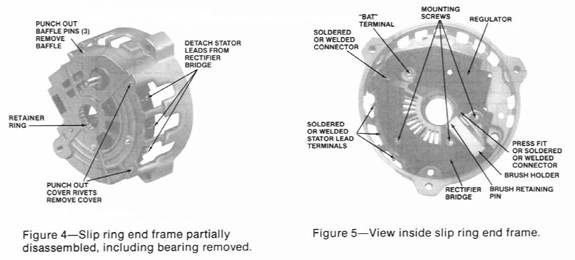
end of shaft when removing nut. To disassemble slip ring end
frame (Figure 4) proceed as follows:
- Punch out cover rivets, or pins, (figure 4), and
discard cover.
- To separate stator from end frame assembly. cut off or
unsolder the leads at rectifier bridge terminals.
- Remove stator.
- Punch out baffle pins, Figure 4, remove baffle.
- Carefully note the position and internal connections so
reassembly can be made correctly as shown in Figure 5.
- Detach fasteners, lift brush holder, regulator. and
rectifier bridge from end frame.
- Unsolder or un-crimp, as needed, the connector to
disconnect regulator from rectifier bridge, and from brush
holder.
Rotor, Field Winding (Stator) Checks
Connect test lamp or ohmmeter from one slip ring to rotor.
If lamp lights, or if reading is low, the rotor winding is
grounded (Figure 6). To check for opens, connect the test
lamp or ohmmeter to each slip ring. If the lamp fails to
light, or if the ohmmeter reading is high (infinite), the
winding is open, replace rotor. If the rotor is not
defective, but the alternator fails to supply rated output.
the defect is in the rectifier bridge. stator, or
regulator.
Page
4....NEXT
PAGE>>>>>